Can You Build a Hurricane-Proof Barndominium in Florida?
What the wind ratings actually mean, what you're required to build, and what's worth the extra money
 Written by Todd Davis — 22-year U.S. Army Veteran, Saint Augustine FL · Updated March 2026
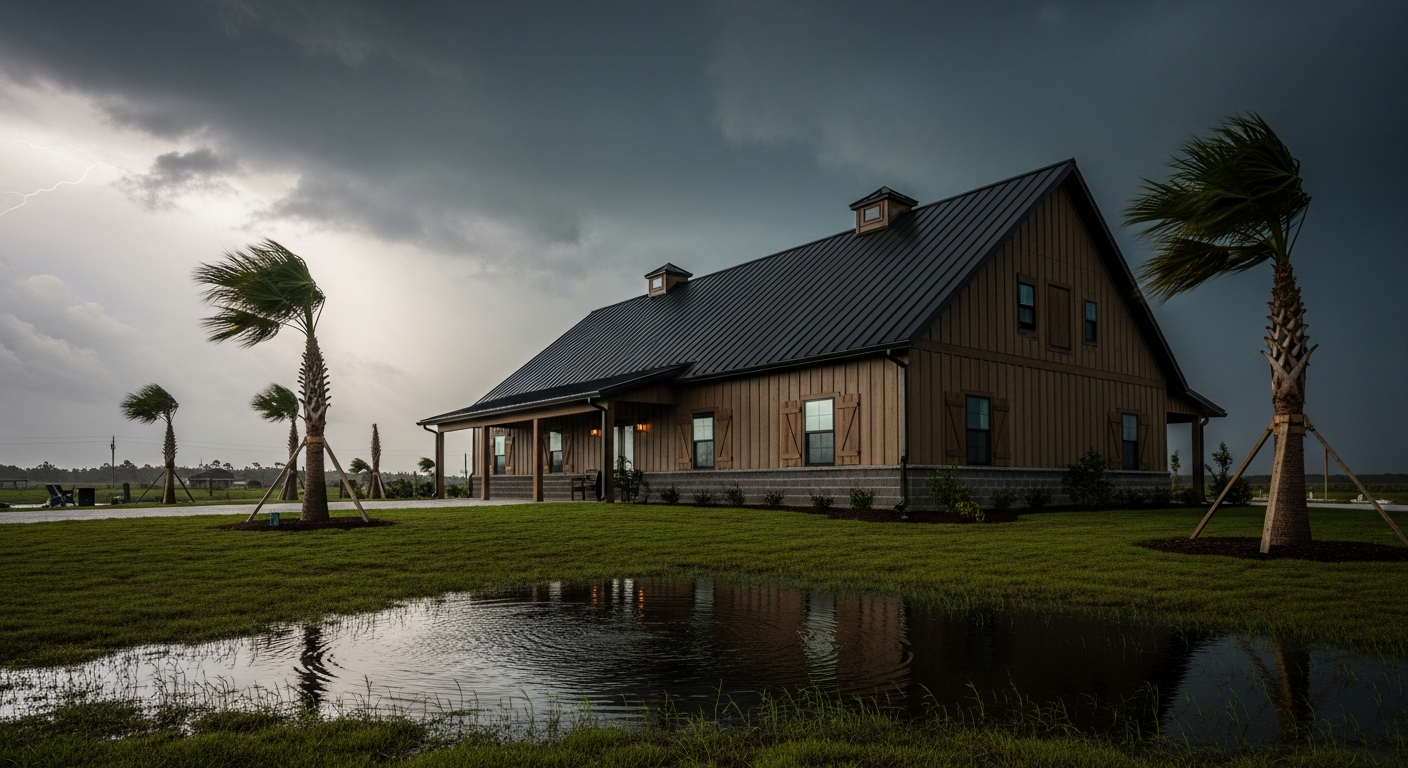
Florida has the most demanding wind load requirements of any state in the continental U.S. If you're planning a barndominium here, you're not just building a home — you're building something that needs to survive 140+ mph wind gusts, flying debris, and potentially days of sustained storm exposure. The good news: barndominiums, built right, are actually one of the more resilient structure types available.
The bad news: "built right" is doing a lot of work in that sentence. Let's go through what that actually means.
What Florida Law Actually Requires
Florida adopted the Florida Building Code (FBC), which is based on the International Building Code but with significant state-specific amendments for wind resistance. In most of North Florida — St. Johns, Duval, Clay, and Flagler counties — you're in a Wind Speed Zone of 130–140 mph (ASCE 7-22 design wind speed). Closer to the coast it goes higher.
Your building must be engineered to withstand these loads. That's not optional. A kit barndominium from a Texas manufacturer that isn't engineered to FBC may not be permitted in Florida. Ask specifically: "Is this design stamped by a Florida-licensed engineer for our county's wind zone?"
Quick Check
Before you buy any barndominium kit or package, ask the manufacturer for their Florida engineer stamp documentation for your specific county. If they can't provide it, the package likely won't pass permitting.
The Roof: Where Most Failures Happen
The majority of hurricane damage to buildings comes from roof failure — and the most common cause of roof failure is uplift. Wind gets under the edge of a roof, and if the connections aren't rated for the load, the roof peels off. Everything else follows.
For a barndominium in Florida, you have two main roof system choices:
Standing Seam Metal
Panels clip to the structure hidden below the surface. No exposed fasteners means fewer penetrations where water or wind can get in.
- ✓ Rated to 160–180 mph when properly installed
- ✓ 40–70 year lifespan in Florida climate
- ✓ Excellent for hurricane strapping connection
- ~ $4–$7/sq ft installed
Exposed Fastener Metal Panel
More common in kit barndominiums. Screws penetrate through the panel. Less expensive but more maintenance-intensive in Florida's wet climate.
- ✓ Rated to 130–150 mph with proper strapping
- ✓ Easier to repair panels individually
- ✗ Screw holes can loosen and leak over time
- ~ $2.50–$4/sq ft installed
Recommendation: in coastal North Florida, spend the extra money on standing seam. The long-term maintenance cost difference more than pays for the upfront premium.
Hurricane Straps and the Frame Connection
A barndominium's steel frame is inherently strong — steel doesn't rot, crack, or warp. But the frame is only as good as its connection to the foundation and the roof-to-wall connection. Florida code requires continuous load path engineering: the structure must be able to transfer wind load from the roof, through the walls, down to the foundation without any single connection becoming the weak link.
Ask your manufacturer for their Load Path Documentation. Any legitimate Florida barndominium package will have this as part of the engineering drawings.
Windows and Doors: Impact vs. Storm Shutters
The Florida Building Code requires all openings in Wind-Borne Debris Regions (within 1 mile of the coast or in high-wind areas) to be protected against debris impact. You have two options:
| Option | Upfront Cost | Pros | Cons |
|---|---|---|---|
| Impact Windows & Doors | $800–$1,500/window | Always protected, no action needed, better insulation, insurance discount | High upfront cost |
| Storm Shutters | $200–$600/opening | Lower upfront cost, works with standard windows | Must be deployed manually, easy to forget, labor-intensive |
For a permanent residence, impact windows are almost always the right call. Insurance companies in Florida typically discount premiums 20–40% for homes with full impact protection. That discount often pays back the window upgrade cost within 7–10 years.
Foundation: What Makes or Breaks the Whole Build
A steel frame barndominium on a properly anchored slab is an extremely durable structure. The key word is properly anchored. Florida's wind code requires anchor bolts or embedded hold-downs that connect the steel frame base plates directly into the concrete slab at engineered intervals.
Most kit manufacturers spec anchor bolt patterns. What varies is the concrete thickness and rebar spec. In Florida, a typical barndominium slab should be a minimum of 6 inches with #4 rebar on 12-inch centers, and thicker at the perimeter grade beam. Cheap sites sometimes spec 4-inch slabs to cut costs — that's a red flag in a hurricane zone.
What Does All This Actually Add to the Cost?
Building to Florida hurricane standards versus a "standard" barndominium in a lower-wind state typically adds $8–$18 per square foot to the overall build cost. Here's where that money goes:
Florida Hurricane Upgrade Cost Breakdown
On a 2,000 sq ft barndominium, you're looking at roughly $16,000–$36,000 in Florida-specific upgrades over a basic kit build. That sounds like a lot until you consider the alternative: rebuilding after a major storm, dealing with denied insurance claims, or failing inspections mid-project.
Is a Steel Barndominium Actually Better Than Wood Frame in a Hurricane?
Yes, with an important caveat. A properly engineered steel barndominium outperforms wood-frame construction in hurricane conditions for several reasons:
- ✓Steel doesn't absorb moisture. Wood-frame structures can deteriorate at connection points after repeated storm exposure. Steel stays dimensionally stable.
- ✓Frame connections are bolted, not nailed. Bolted steel connections have dramatically higher uplift resistance than nail patterns in wood framing.
- ✓Steel is non-combustible. Post-hurricane fires are a real risk. Steel doesn't add fuel.
- !The caveat: An improperly built steel barndominium — bad anchoring, wrong wind zone spec, inadequate openings protection — will fail just as badly as any wood frame structure. The material doesn't save you if the engineering is wrong.
3 Questions to Ask Every Florida Barndominium Builder
1. "Do your plans include a Florida-licensed engineer stamp for my county's wind zone?"
Any legitimate builder should have this or be able to get it. A "no" here is a stop sign.
2. "What is the design wind speed rating for the structure as supplied?"
You want 140 mph or higher in North Florida. If they can't give you a number, the answer tells you something.
3. "Have you built in St. Johns / Duval / Clay / Flagler County before, and can you reference past permits?"
Local permitting experience is worth a lot. A builder who's navigated Florida county inspectors before knows exactly what will and won't fly.
Bottom Line
Yes, you can build a genuinely hurricane-resistant barndominium in Florida. Steel-frame construction is well-suited for it. But you have to build it to Florida's actual wind code — not to a generic kit spec from a non-Florida supplier. The upgrades cost money. They're worth it.
Todd Davis
22-year U.S. Army Veteran · Saint Augustine, FL · Modular Space Systems Founder
I've watched neighbors lose roofs in storms because their contractor cut corners on anchoring. North Florida weather is not theoretical — it shows up. Build to the code, then build a little beyond it.
Get Quotes From Florida-Experienced Builders
We only connect you with suppliers who know Florida's wind code. Free, no obligation.
Compare Free Quotes NowOr call: 1-888-248-7899